

Passenger Elevator Or Lift Modernization Vs. Replacement: How To Choose
A slow, unreliable passenger elevator is more than an inconvenience; it affects tenant satisfaction, accessibility, safety perception, and long-term asset value. For many buildings, the critical decision arrives after roughly 20 to 25 years of service: upgrade the existing lift system or replace it entirely. The right answer depends on condition, capacity, code requirements, downtime tolerance, and total lifecycle cost-not just the lowest bid. This guide explains what modernization typically includes, when a full replacement becomes the smarter investment, and how to compare cost, reliability, compliance, and return on investment before committing capital.
Passenger Elevator Modernization vs Full ReplacementYou have been hearing the complaints for months: the passenger elevator is sluggish, the leveling is slightly off, and the doors seem to have a mind of their own. When your building's lift hits that critical 20 to 25-year mark, you are faced with a massive capital planning headache. Do you breathe new life into the existing system through modernization, or do you bite the bullet and tear it down for a full replacement? It is not just a coin toss; making the right choice hinges on your building's current infrastructure, budget constraints, and tenant expectations.What Elevator Modernization IncludesModernization is not just a cosmetic facelift for the cab interior. It focuses on replacing the critical moving parts and electronic brains of the lift while keeping the heavy structural elements intact. During a standard modernization, technicians will retain the guide rails, counterweights, and the main cab shell. Meanwhile, you are typically upgrading the old relay-based controller to a modern microprocessor system, swapping out the aging DC motor for an efficient AC gearless machine, and installing brand-new, highly responsive door operators.
By reusing the heavy steel components and avoiding major structural alterations, you can usually save 40% to 50% on capital costs compared to a complete tear-out. Plus, a comprehensive modernization can easily extend your elevator's reliable lifespan by another 15 to 20 years, drastically cutting down on those expensive middle-of-the-night service calls and improving overall ride quality.When Full Replacement Makes More SenseSometimes, salvaging the old system is just throwing good money after bad. If your building's usage has shifted drastically-say, moving from a standard corporate office to a high-density medical facility-your existing 2,500 lb capacity lift might simply be too small for the new foot traffic, no matter how shiny the new destination dispatch buttons are.
Full replacement is usually the smarter play when cumulative repair costs start creeping past 60% of the price of a brand-new system. It is also necessary if your hoistway configuration needs to fundamentally change, or if you are dealing with proprietary legacy equipment where replacement parts carry a frustrating lead time of 12+ weeks. When the underlying architecture is fundamentally flawed or completely obsolete, starting fresh is your only real path forward.How to Compare Cost, Downtime, and Compliance
Once you understand the basic mechanical differences, it is time to crunch the numbers. You have to look beyond the initial invoice and factor in how long your building will be an active construction zone, as well as the ongoing operational costs. Let's break down the comparative metrics that matter most to your bottom line.Cost, Lifecycle, and ROI FactorsThe financial debate usually comes down to initial capital outlay versus long-term return on investment. Modernization wins heavily on upfront costs and minimizing downtime, but a full replacement gives you a blank slate for maximum efficiency and modern space utilization. Consider upgrading to regenerative drives during either process; they capture heat generated during braking and convert it back into electricity, which can drop your elevator's energy consumption by up to 35%.
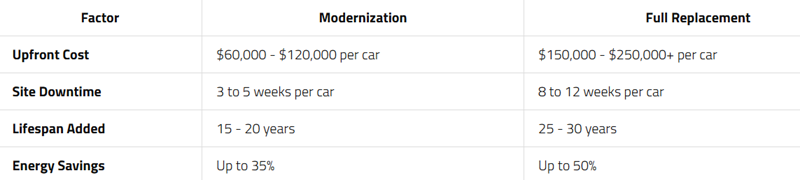
Keep in mind that downtime is not just a minor inconvenience; it has a hard dollar value if you have to offer rent concessions to frustrated tenants. If you manage a single-car boutique building, shutting down the only lift for 10 weeks for a full replacement might be an absolute dealbreaker for your occupants.Safety, Code, and Site ConstraintsSafety codes are constantly evolving, and your 1990s lift is likely falling behind. Both modernization and replacement will force you to bring the system up to current standards, such as ASME A17.1 in the US or EN 81-20 in Europe. This means integrating two-way video communication, advanced door restrictors, and unintended car movement protection (UCMP).
However, physical site constraints can quickly force your hand. If your existing elevator pit depth is only 4 feet, but modern codes for your required speed demand a 5-foot pit, a full replacement might trigger massive, costly structural concrete work. Modernization often allows you to utilize code variances grandfathered in for existing structures, keeping your project within feasible physical boundaries and avoiding a logistical nightmare.